
बहुत अच्छा सवाल 👍
अब मैं आपको हर Tense (काल) के लिए यह भी बताऊँगा कि हिंदी में कैसे पहचानें (कौन-से शब्द या अंत आपको संकेत देंगे)। इससे हिंदी मीडियम बच्चों को बहुत आसानी होगी।
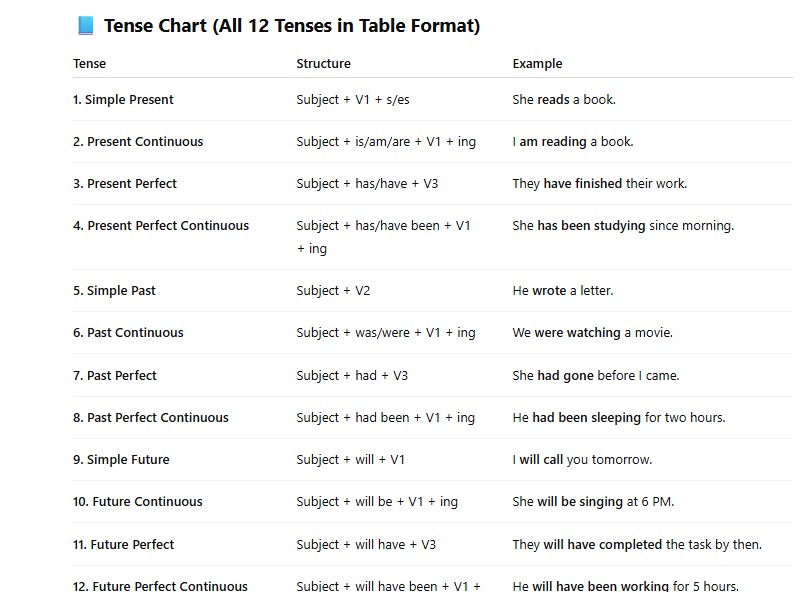
Tense Chart (with पहचान + Example)
| Tense (काल) | हिंदी में पहचान | Rule / Helping Verb | Example (English) | उदाहरण (Hindi) |
|---|---|---|---|---|
| Present Indefinite (साधारण वर्तमान) | अंत में अक्सर ता है, ती है, ते हैं आता है | Verb 1 (s/es with he, she, it) | I play cricket. | मैं क्रिकेट खेलता हूँ। |
| Present Continuous (वर्तमान निरंतर) | अंत में रहा है, रही है, रहे हैं आता है | is/ am/ are + V1+ing | She is reading. | वह पढ़ रही है। |
| Present Perfect (पूर्ण वर्तमान) | अंत में चुका है, चुकी है, चुके हैं आता है | has/have + V3 | They have eaten food. | उन्होंने खाना खा लिया है। |
| Present Perfect Continuous (पूर्ण निरंतर वर्तमान) | अंत में से + रहा है/रही है/रहे हैं आता है | has/have been + V1+ing | He has been working for 2 hours. | वह 2 घंटे से काम कर रहा है। |
| Past Indefinite (साधारण भूत) | अंत में या, ई, ए आता है | Verb 2 | I went to school. | मैं स्कूल गया। |
| Past Continuous (भूत निरंतर) | अंत में रहा था, रही थी, रहे थे आता है | was/were + V1+ing | He was sleeping. | वह सो रहा था। |
| Past Perfect (पूर्ण भूत) | अंत में चुका था, चुकी थी, चुके थे आता है | had + V3 | They had left before I came. | मेरे आने से पहले वे जा चुके थे। |
| Past Perfect Continuous (पूर्ण निरंतर भूत) | अंत में से + रहा था/रही थी/रहे थे आता है | had been + V1+ing | She had been singing for 1 hour. | वह 1 घंटे से गा रही थी। |
| Future Indefinite (साधारण भविष्य) | अंत में गा, गी, गे आता है | will/shall + V1 | I will go to market. | मैं बाजार जाऊँगा। |
| Future Continuous (भविष्य निरंतर) | अंत में रहा होगा, रही होगी, रहे होंगे आता है | will/shall + be + V1+ing | They will be playing. | वे खेल रहे होंगे। |
| Future Perfect (पूर्ण भविष्य) | अंत में चुका होगा, चुकी होगी, चुके होंगे आता है | will/shall + have + V3 | He will have finished work. | वह काम पूरा कर चुका होगा। |
| Future Perfect Continuous (पूर्ण निरंतर भविष्य) | अंत में से + रहा होगा/रही होगी/रहे होंगे आता है | will/shall + have been + V1+ing | I will have been studying for 2 hours. | मैं 2 घंटे से पढ़ रहा होऊँगा। |
✅ WHAT IS TENSE? (काल क्या होता है?)
Tense tells the time of an action.
Tense बताता है कि काम कब हुआ, हो रहा है या होगा।
There are 3 main tenses and each has 4 sub-tenses:
| Main Tense | Sub Tenses |
|---|---|
| Present | Simple, Continuous, Perfect, Perfect Continuous |
| Past | Simple, Continuous, Perfect, Perfect Continuous |
| Future | Simple, Continuous, Perfect, Perfect Continuous |
✅ 1. PRESENT TENSE (वर्तमान काल)
🔹 A. SIMPLE PRESENT
Rule:
- Affirmative: S + V¹ + s/es
- Negative: S + do/does not + V¹
- Interrogative: Do/Does + S + V¹?
Hindi पहचान:
👉 sentence ends with “ता है, ती है, ते हैं”
| Form | Example |
|---|---|
| Affirmative | He plays cricket. |
| Negative | He does not play cricket. |
| Interrogative | Does he play cricket? |
🔹 B. PRESENT CONTINUOUS
Rule:
- S + is/am/are + V¹ + ing
Hindi पहचान:
👉 “रहा है, रही है, रहे हैं”
| Form | Example |
|---|---|
| Affirmative | She is cooking food. |
| Negative | She is not cooking food. |
| Interrogative | Is she cooking food? |
🔹 C. PRESENT PERFECT
Rule:
- S + has/have + V³
Hindi पहचान:
👉 “चुका है, चुकी है, चुके हैं”
| Form | Example |
|---|---|
| Affirmative | I have finished my work. |
| Negative | I have not finished my work. |
| Interrogative | Have I finished my work? |
🔹 D. PRESENT PERFECT CONTINUOUS
Rule:
- S + has/have been + V¹ + ing + since/for
Hindi पहचान:
👉 “से रहा है”
| Form | Example |
|---|---|
| Affirmative | I have been studying for 2 hours. |
| Negative | I have not been studying for 2 hours. |
| Interrogative | Have I been studying for 2 hours? |
✅ 2. PAST TENSE (भूतकाल)
🔹 A. SIMPLE PAST
Rule:
- S + V²
Hindi पहचान:
👉 “था, थी, थे” / “या, यी, ए”
| Form | Example |
|---|---|
| Affirmative | I wrote a letter. |
| Negative | I did not write a letter. |
| Interrogative | Did I write a letter? |
🔹 B. PAST CONTINUOUS
Rule:
- S + was/were + V¹ + ing
Hindi पहचान:
👉 “रहा था, रही थी”
| Form | Example |
|---|---|
| Affirmative | She was dancing. |
| Negative | She was not dancing. |
| Interrogative | Was she dancing? |
🔹 C. PAST PERFECT
Rule:
- S + had + V³
Hindi पहचान:
👉 “चुका था”
| Form | Example |
|---|---|
| Affirmative | I had completed the work. |
| Negative | I had not completed the work. |
| Interrogative | Had I completed the work? |
🔹 D. PAST PERFECT CONTINUOUS
Rule:
- S + had been + V¹ + ing + since/for
Hindi पहचान:
👉 “से रहा था”
| Form | Example |
|---|---|
| Affirmative | I had been waiting for 2 hours. |
| Negative | I had not been waiting for 2 hours. |
| Interrogative | Had I been waiting for 2 hours? |
✅ 3. FUTURE TENSE (भविष्य काल)
🔹 A. SIMPLE FUTURE
Rule:
- S + will/shall + V¹
Hindi पहचान:
👉 “गा, गी, गे”
| Form | Example |
|---|---|
| Affirmative | I will go to Delhi. |
| Negative | I will not go to Delhi. |
| Interrogative | Will I go to Delhi? |
🔹 B. FUTURE CONTINUOUS
Rule:
- S + will be + V¹ + ing
Hindi पहचान:
👉 “रहा होगा”
| Form | Example |
|---|---|
| Affirmative | I will be working. |
| Negative | I will not be working. |
| Interrogative | Will I be working? |
🔹 C. FUTURE PERFECT
Rule:
- S + will have + V³
Hindi पहचान:
👉 “चुका होगा”
| Form | Example |
|---|---|
| Affirmative | I will have finished the work. |
| Negative | I will not have finished the work. |
| Interrogative | Will I have finished the work? |
🔹 D. FUTURE PERFECT CONTINUOUS
Rule:
- S + will have been + V¹ + ing + since/for
Hindi पहचान:
👉 “से रहा होगा”
| Form | Example |
|---|---|
| Affirmative | I will have been studying for 2 hours. |
| Negative | I will not have been studying for 2 hours. |
| Interrogative | Will I have been studying for 2 hours? |
✅ HOW TO IDENTIFY TENSE? (पहचान कैसे करें)
🔹 Step-1: Look at Hindi verb ending
| Hindi Word | Tense |
|---|---|
| ता/ती/ते | Simple Present |
| रहा/रही | Continuous |
| चुका/चुकी | Perfect |
| से रहा | Perfect Continuous |
| था/थी | Past |
| होगा/होगी | Future |
🔹 Step-2: Look at English helping verb
| Helping Verb | Tense |
|---|---|
| do/does | Simple Present |
| is/am/are | Present Continuous |
| has/have | Present Perfect |
| was/were | Past Continuous |
| had | Past Perfect |
| will | Future |
✅ HOW TO CHANGE SENTENCE INTO ALL 3 FORMS
Example:
He eats food.
- Affirmative: He eats food.
- Negative: He does not eat food.
- Interrogative: Does he eat food?
✅ Rule Trick:
- Negative → add not
- Interrogative → bring helping verb before subject
✅ QUICK MASTER CHART (One Glance Revision)
| Tense | Helping Verb | V Form |
|---|---|---|
| Simple Present | do/does | V¹ |
| Present Continuous | is/am/are | V¹+ing |
| Present Perfect | has/have | V³ |
| Simple Past | did | V¹ |
| Past Continuous | was/were | V¹+ing |
| Past Perfect | had | V³ |
| Simple Future | will | V¹ |
| Future Continuous | will be | V¹+ing |
| Future Perfect | will have | V³ |
If you want, I can also provide:
✅ 100 tense practice questions
✅ Tense Voice Change Rules
✅ Active–Passive Tense Chart
✅ Tense Worksheet PDF for students
👉 Tell me your class level (5–12 or competitive exam?) and I will customize it for you.
👉 अब पहचान आसान है:
- ता/ती/ते है → Present Indefinite
- रहा/रही/रहे है → Present Continuous
- चुका है/हूँ → Present Perfect
- से रहा है/हूँ → Present Perfect Continuous
- या, ई, ए → Past Indefinite
- रहा था/रही थी → Past Continuous
- चुका था → Past Perfect
- से रहा था → Past Perfect Continuous
- गा/गी/गे → Future Indefinite
- रहा होगा → Future Continuous
- चुका होगा → Future Perfect
- से रहा होगा → Future Perfect Continuous
हर Tense (काल) के लिए 5-5 हिंदी वाक्य द
1. Present Tense (वर्तमान काल)
(a) Present Indefinite (साधारण वर्तमान)
पहचान: “ता है, ती है, ते हैं”
- मैं रोज़ स्कूल जाता हूँ। → I go to school every day.
- वह किताब पढ़ती है। → She reads a book.
- वे खेलते हैं। → They play.
- सूरज पूर्व से निकलता है। → The sun rises in the east.
- हम गाना गाते हैं। → We sing a song.
(b) Present Continuous (वर्तमान निरंतर)
पहचान: “रहा है, रही है, रहे हैं”
- वह खाना खा रहा है। → He is eating food.
- वह गाना गा रही है। → She is singing.
- बच्चे खेल रहे हैं। → Children are playing.
- मैं पढ़ रहा हूँ। → I am studying.
- हम बाज़ार जा रहे हैं। → We are going to the market.
(c) Present Perfect (पूर्ण वर्तमान)
पहचान: “चुका है, चुकी है, चुके हैं”
- मैंने होमवर्क कर लिया है। → I have done my homework.
- वह बाज़ार जा चुकी है। → She has gone to the market.
- उन्होंने खाना खा लिया है। → They have eaten the food.
- वह काम पूरा कर चुका है। → He has finished the work.
- हम फिल्म देख चुके हैं। → We have watched the movie.
(d) Present Perfect Continuous (पूर्ण निरंतर वर्तमान)
पहचान: “से रहा है, से रही है, से रहे हैं”
- मैं दो घंटे से पढ़ रहा हूँ। → I have been studying for two hours.
- वह सुबह से गा रही है। → She has been singing since morning.
- वे कल से खेल रहे हैं। → They have been playing since yesterday.
- हम एक घंटे से बात कर रहे हैं। → We have been talking for one hour.
- वह लंबे समय से यहाँ काम कर रहा है। → He has been working here for a long time.
2. Past Tense (भूतकाल)
(a) Past Indefinite (साधारण भूत)
पहचान: “या, ई, ए”
- मैंने खाना खाया। → I ate food.
- वह स्कूल गया। → He went to school.
- वह बाज़ार गई। → She went to the market.
- वे क्रिकेट खेले। → They played cricket.
- हमने फिल्म देखी। → We watched a movie.
(b) Past Continuous (भूत निरंतर)
पहचान: “रहा था, रही थी, रहे थे”
- मैं किताब पढ़ रहा था। → I was reading a book.
- वह गाना गा रही थी। → She was singing.
- बच्चे खेल रहे थे। → Children were playing.
- वे बाज़ार जा रहे थे। → They were going to the market.
- हम बातें कर रहे थे। → We were talking.
(c) Past Perfect (पूर्ण भूत)
पहचान: “चुका था, चुकी थी, चुके थे”
- मैंने काम पूरा कर लिया था। → I had completed the work.
- वह स्कूल जा चुकी थी। → She had gone to school.
- वे खेल चुके थे। → They had played.
- मैंने खाना खा लिया था। → I had eaten food.
- हम फिल्म देख चुके थे। → We had watched the movie.
(d) Past Perfect Continuous (पूर्ण निरंतर भूत)
पहचान: “से रहा था, से रही थी, से रहे थे”
- मैं दो घंटे से पढ़ रहा था। → I had been studying for two hours.
- वह सुबह से गा रही थी। → She had been singing since morning.
- वे कल से खेल रहे थे। → They had been playing since yesterday.
- हम एक घंटे से बातें कर रहे थे। → We had been talking for an hour.
- वह लंबे समय से काम कर रहा था। → He had been working for a long time.
3. Future Tense (भविष्यकाल)
(a) Future Indefinite (साधारण भविष्य)
पहचान: “गा, गी, गे”
- मैं स्कूल जाऊँगा। → I will go to school.
- वह बाज़ार जाएगी। → She will go to the market.
- वे खेलेंगे। → They will play.
- हम फिल्म देखेंगे। → We will watch a movie.
- वह किताब पढ़ेगा। → He will read a book.
(b) Future Continuous (भविष्य निरंतर)
पहचान: “रहा होगा, रही होगी, रहे होंगे”
- मैं किताब पढ़ रहा होऊँगा। → I will be reading a book.
- वह खाना खा रही होगी। → She will be eating food.
- वे खेल रहे होंगे। → They will be playing.
- हम बातें कर रहे होंगे। → We will be talking.
- वह काम कर रहा होगा। → He will be working.
(c) Future Perfect (पूर्ण भविष्य)
पहचान: “चुका होगा, चुकी होगी, चुके होंगे”
- मैं काम पूरा कर चुका होऊँगा। → I will have completed the work.
- वह बाज़ार जा चुकी होगी। → She will have gone to the market.
- वे खेल चुके होंगे। → They will have played.
- हम फिल्म देख चुके होंगे। → We will have watched the movie.
- वह खाना खा चुका होगा। → He will have eaten the food.
(d) Future Perfect Continuous (पूर्ण निरंतर भविष्य)
पहचान: “से रहा होगा, से रही होगी, से रहे होंगे”
- मैं दो घंटे से पढ़ रहा होऊँगा। → I will have been studying for two hours.
- वह सुबह से गा रही होगी। → She will have been singing since morning.
- वे कल से खेल रहे होंगे। → They will have been playing since yesterday.
- हम एक घंटे से बातें कर रहे होंगे। → We will have been talking for one hour.
- वह लंबे समय से काम कर रहा होगा। → He will have been working for a long time.
✅ WH-family interrogative rules (tense-wise)
✅ Use of S / ES in Simple Present (clear rules)
✅ Use of SINCE & FOR in Perfect Continuous with time
✅ ADDITION–1
🔹 WH-FAMILY INTERROGATIVE RULES (TENSE WISE)
WH Words:
👉 What, When, Where, Why, Who, Whom, Which, Whose, How
🔹 GENERAL FORMULA (ALL TENSES):
WH + Helping Verb + Subject + Main Verb?
✅ A. SIMPLE PRESENT (WH-Questions)
Rule:
WH + do/does + subject + V¹ ?
Examples:
- What do you want?
- Where does he live?
- Why do they study?
❗ If WHO is the subject → no do/does used
- Who teaches you? ✅
- Who calls you daily? ✅
✅ B. PRESENT CONTINUOUS (WH)
Rule:
WH + is/am/are + subject + V¹ + ing ?
Examples:
- What are you doing?
- Where is she going?
- Why are they crying?
✅ C. PRESENT PERFECT (WH)
Rule:
WH + has/have + subject + V³ ?
Examples:
- What have you done?
- Where has he gone?
- Why have they stopped?
✅ D. PRESENT PERFECT CONTINUOUS (WH)
Rule:
WH + has/have + subject + been + V¹+ing + since/for ?
Examples:
- What have you been doing for 2 hours?
- Since when has he been working here?
✅ E. SIMPLE PAST (WH)
Rule:
WH + did + subject + V¹ ?
Examples:
- What did you eat?
- Where did she go?
- Why did they fight?
✅ F. PAST CONTINUOUS (WH)
Rule:
WH + was/were + subject + V¹+ing ?
Examples:
- What were you doing?
- Where was she going?
✅ G. PAST PERFECT (WH)
Rule:
WH + had + subject + V³ ?
Examples:
- What had you done?
- Why had he left?
✅ H. FUTURE SIMPLE (WH)
Rule:
WH + will + subject + V¹ ?
Examples:
- What will you do tomorrow?
- Where will she go?
✅ I. FUTURE CONTINUOUS (WH)
Rule:
WH + will + subject + be + V¹+ing ?
Example:
- What will you be doing at 8 pm?
✅ J. FUTURE PERFECT (WH)
Rule:
WH + will + subject + have + V³ ?
Example:
- What will you have completed by Monday?
✅ K. FUTURE PERFECT CONTINUOUS (WH)
Rule:
WH + will + subject + have been + V¹+ing + since/for ?
Example:
- How long will you have been working here?
✅ ADDITION–2
🔹 SIMPLE PRESENT: USE OF S / ES WITH VERB
✅ Rule:
When subject is He, She, It, or Singular Noun →
➡ Add S / ES to the verb.
✅ When to add S
If verb ends normally:
- play → plays
- eat → eats
- live → lives
✅ When to add ES
If verb ends with:
- s, sh, ch, x, o
| Verb | Form |
|---|---|
| go | goes |
| watch | watches |
| teach | teaches |
| wash | washes |
| pass | passes |
✅ Y Rule
- If consonant + y → y → ies
- cry → cries
- carry → carries
- If vowel + y → only s
- play → plays
- enjoy → enjoys
✅ Negative & Interrogative
❗ When does is used → verb becomes V¹
- He does not play ❌ NOT plays
- Does he play? ✅
✅ ADDITION–3
🔹 PERFECT CONTINUOUS: USE OF SINCE & FOR (TIME RULE)
Used in:
- Present Perfect Continuous
- Past Perfect Continuous
- Future Perfect Continuous
✅ ✅ FOR = Period of Time (कितनी देर से)
Used with duration:
- 10 minutes
- 2 hours
- 5 years
- a long time
Examples:
- I have been studying for 2 hours.
- She had been working for 5 years.
- He will have been waiting for 30 minutes.
✅ ✅ SINCE = Point of Time (कब से)
Used with starting time:
- morning
- Monday
- 2018
- 5 o’clock
Examples:
- I have been studying since morning.
- She had been living here since 2019.
- They will have been working since Monday.
✅ Common Mistakes to Avoid
❌ since 2 hours → WRONG
✅ for 2 hours → CORRECT
❌ for morning → WRONG
✅ since morning → CORRECT
✅ FINAL QUICK REMEMBER TRICK
| Word | Use |
|---|---|
| Since | Start Time |
| For | Duration |